
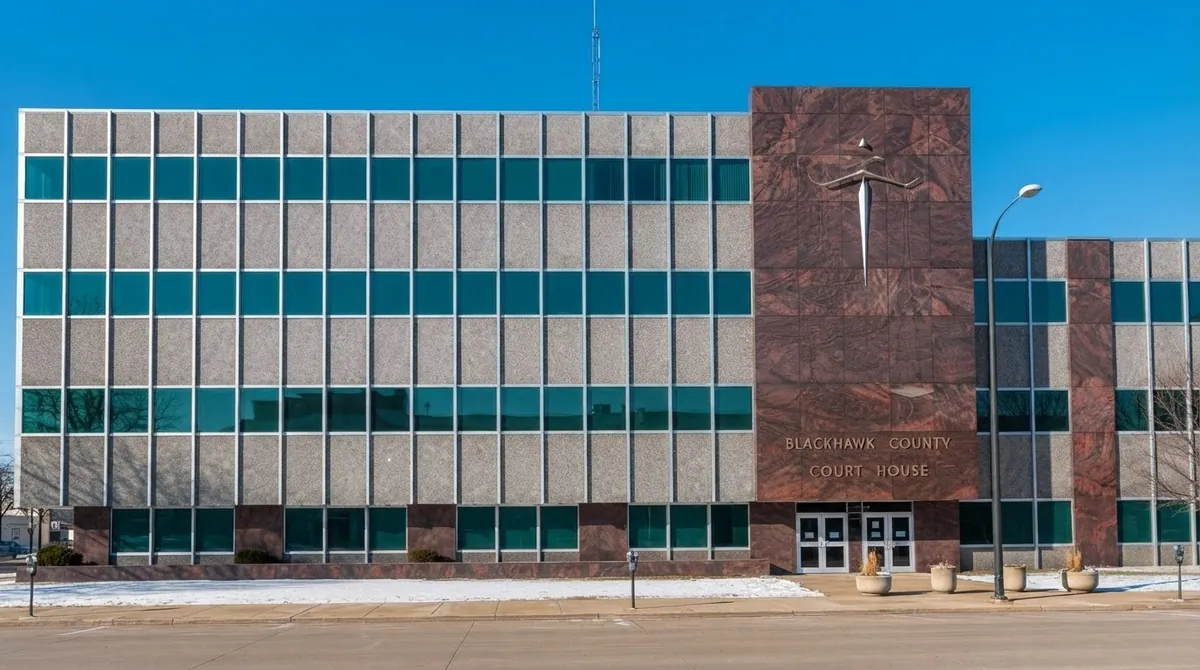
Court records in Black Hawk County, Iowa are maintained by the clerk of the district court and can be accessed through online tools, official court portals, and the clerk's office. BlackHawkCourt.us can help you find publicly available court record information for Black Hawk County. You can also search records through the Iowa Courts Online docket search, contact the clerk directly, or visit the courthouse in Waterloo for in-person assistance.
Black Hawk Court System Overview
Black Hawk County is part of Iowa Judicial District 1, which also includes Allamakee, Black Hawk, Buchanan, Chickasaw, Clayton, Delaware, Dubuque, Fayette, Grundy, Howard, and Winneshiek counties. The Iowa District Court for Black Hawk County has general jurisdiction over all civil, criminal, juvenile, family, and probate matters. The magistrate division operates within the district court and handles smaller civil disputes, simple misdemeanors, and preliminary hearings. Black Hawk County is one of the larger counties in the district, with its courthouse located in Waterloo.
Courts Serving Black Hawk
Several courts serve Black Hawk County residents at the state and federal level:
| Court | Address / Contact |
|---|---|
| Iowa District Court – Black Hawk County (includes Magistrate Division) | 316 E 5th Street |
| U.S. District Court – Northern District of Iowa (Waterloo Division) | 111 7th Avenue SE, Box 6 |
| U.S. Bankruptcy Court – Northern District of Iowa | 111 7th Avenue SE |
Iowa does not have separate municipal courts. All local-level matters, including traffic and ordinance violations, are handled through the district court's magistrate division.
What Types of Cases Black Hawk Courts Hear
The district court in Black Hawk County has jurisdiction over virtually all case types, including:
- Felonies, misdemeanors, and simple misdemeanors
- Traffic violations and infractions
- Civil litigation (all dollar amounts)
- Small claims
- Family law — divorce, custody, child support, paternity, protection orders
- Probate — estates, guardianships, conservatorships
- Juvenile — delinquency and child protective proceedings
- Adoption and termination of parental rights
The sections below explain which division — district or magistrate — handles each category.
District Court Cases in Black Hawk
District court judges in Black Hawk County preside over felony criminal cases, civil lawsuits exceeding $6,500, equity actions, appeals from magistrate court, and post-conviction relief proceedings. Felony cases typically arrive at the district level after a preliminary hearing or grand jury indictment. Civil cases are initiated by filing a petition, and cases are assigned to a district judge or district associate judge. The court also handles dissolution of marriage, custody disputes, probate matters, and juvenile proceedings. Cases move through scheduling conferences, pretrial motions, and either trial or settlement.
Magistrate Court Cases in Black Hawk
The magistrate division in Black Hawk County handles:
- Simple misdemeanors — including traffic violations, minor drug offenses, and local ordinance violations
- Felony preliminary hearings — to determine probable cause before bindover to district court
- Civil cases up to $6,500 — the jurisdictional limit for magistrate civil actions under Iowa law
- Small claims up to $6,500 — informal proceedings without attorneys required
- Search warrant applications and initial appearances
- Scheduled violations — including parking and certain regulatory infractions
Magistrate judges are appointed and handle high-volume dockets. DUI arraignments and initial hearings on serious and aggravated misdemeanors also begin in the magistrate division before being assigned to a district associate judge or district judge.
Family Law, Probate, and Juvenile Matters in Black Hawk
Family Law
Divorce, custody, child support, paternity, civil protection orders, and termination of parental rights are all filed in district court. District judges and district associate judges preside over these cases. Protection order petitions can be filed without an attorney and are typically heard on an expedited schedule.
Probate
Decedent estates, guardianships, conservatorships, and trust matters are handled by the district court. Probate filings are made through the clerk's office, and Iowa requires electronic filing for most documents. Court forms for probate matters are available through the Iowa Judicial Branch website.
Juvenile
Juvenile delinquency proceedings and child-in-need-of-assistance (CINA) cases are heard in district court. Juvenile court records are confidential under Iowa law and are not available through public docket searches. Juvenile Court Services for Black Hawk County operates through the First Judicial District and coordinates with the court on supervision, diversion, and case management.
How Cases Move Through the Black Hawk Court System
- Filing / Initiation: Criminal cases begin with a complaint or information filed by the county attorney. Civil cases start with a petition filed by the plaintiff. Family and probate matters begin with a petition.
- Assignment: The clerk assigns the case to a judge. Criminal cases may begin in magistrate court for initial appearances and preliminary hearings.
- Initial Hearing: In criminal cases, the defendant is arraigned and advised of charges. In civil cases, a scheduling conference sets deadlines for discovery and motions.
- Pre-Trial Phase: Parties exchange evidence, file motions, and may negotiate plea agreements (criminal) or settlements (civil).
- Trial or Resolution: Cases proceed to bench or jury trial, or resolve through plea, settlement, dismissal, or default judgment.
- Post-Judgment: Criminal cases move to sentencing and possible appeal. Civil cases may involve enforcement of judgment, garnishment, or appeal to the Iowa Court of Appeals.
Court Administration, Local Rules, and Public Access in Black Hawk
The courts in Black Hawk County are administered under Iowa Judicial District 1, led by the chief judge of the district. The trial court administrator's office oversees day-to-day operations, scheduling, and court staffing. Contact the clerk's office at 319-291-2506 or blackhawk.county.clerk@iowacourts.gov for administrative questions.
Local Rules
Local court rules for the First Judicial District are published through the Iowa Judicial Branch website. These rules supplement the Iowa Rules of Civil Procedure and cover scheduling, motion practice, and courtroom conduct.
Public Access
Under Iowa Court Rules Chapter 16, most court records are presumed open to the public. Exceptions include:
- Juvenile records
- Sealed records (by court order)
- Adoption records
- Mental health commitment records
- Certain financial information in family law cases
You can search publicly available docket information through the Iowa Courts Online search tool. For certified copies or records not available online, submit a request to the clerk's office in person or by mail.
Attending Hearings
Most hearings in Black Hawk County are open to the public. Some proceedings may be available by telephone or video at the court's discretion. Contact the clerk's office to ask about remote attendance options for a specific hearing.
Court Records and Related Court Resources in Black Hawk
- Court Docket Search: Use Iowa Courts Online to search case dockets by party name, case number, or attorney across all Iowa district courts, including Black Hawk County.
- Court Forms and Self-Help: The Iowa Judicial Branch court forms page provides downloadable and interactive forms for civil, criminal, family, probate, and small claims filings.
- Clerk of Court / Public Records Requests: Contact the Black Hawk County Clerk of Court at 319-291-2506 to request copies of court records, inquire about case status, or submit a public records request.
- Criminal History Background Checks: The Iowa Division of Criminal Investigation processes statewide criminal history record checks. You can also request a background check through Iowa.gov.
- Iowa DOC Offender Search: The Iowa Department of Corrections offender search allows you to look up current and former inmates in the state correctional system.
- Sheriff's Office: The Black Hawk County Sheriff's Office publishes active warrant information and handles weapons permits, civil process, and court security at 225 E 6th Street, Waterloo, IA 50703.
- County Recorder: The Black Hawk County Recorder maintains land records, liens, and other recorded documents that may relate to civil court proceedings.
- Vital Records: Birth, death, and marriage certificates are available through Iowa Health and Human Services Vital Records. These are not court records but are often needed alongside family law or probate filings.
- Property and Tax Records: The Black Hawk County Assessor and Black Hawk County Treasurer handle property assessments and tax payment records, which may be relevant in civil litigation or probate matters.